Morning Coffee: Jefferies says it stands to lose $43m but its market cap is down $4bn. Goldman Sachs banker fired for saying things about Trump
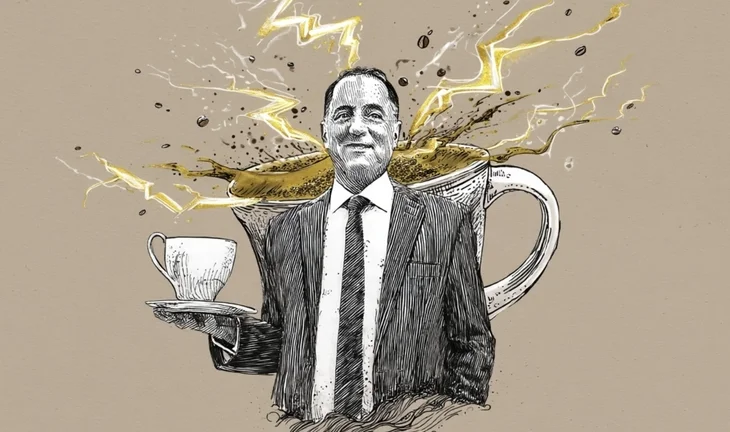
It's been a few days coming, but we now have it: Richard Handler and Brian Freeman of Jefferies have written a letter. Both men like to do this, but the letter is less chummily jovial than many of its predecessors.
Get Morning Coffee ☕ in your inbox. Sign up here.
The Financial Times notes that Rich and Brian think Jefferies has been unfairly treated by the market in the First Brands affair. Jefferies' market cap has descended from a peak of $15bn in mid-September to just below $11bn at the end of last week. This is "meaningfully" overdone, say the two men. Once everyone realises that Jefferies is ok, Rich and Brian say the share price will "correct soon."
That would be nice. Jefferies' share price fell 18% last week and 8% in after hours trading on Friday. At issue is the bank's complex relationship with First Brands, a car-parts supplier from Ohio run by a mysterious man who never turns his camera on in meetings, which went bankrupt on September 29th. Jefferies is primarily connected to First Brands via Leucadia, a meat-packing and car-parts business with which Jefferies itself merged in 2022. Leucadia Asset Management runs a fund called Point Bonita Capital, which in turn has invested $715m in First Brands.
The main fear is that the First Brands collapse might be far worse than it appears. An investigation is being conducted into whether the the invoices that were supposed to be the collateral for loans made to First Brands were actually used over and over again. As the Financial Times observes, this would be akin to, "taking out nine mortgages against your house, with the lenders all blissfully unaware that eight other banks also have a claim on the property." Things could get messy.
The fear is also that Jefferies will suffer reputational risk from its involvement with First Brands. As Bloomberg noted, Jefferies has been First Brands' banker for over a decade as the company hoovered up small suppliers of car parts to become the giant conglomerate bankers knew and loved. Jefferies never seemed to notice anything wrong. In fact, Jefferies was pitching investors on a $6bn refinancing deal for First Brands as recently as July.
But it's not so bad, say Rich and Brian. That July refinancing never happened. Jefferies' bankers pulled out after conducting "diligence." Most specifically, they requested a "quality of earnings" report which First Brands never provided. (Bloomberg notes that Jefferies in fact paused the refinancing while promising a "fulsome" quality of earnings report from a bigger accounting firm.) Jefferies had no idea of the fraud allegations against First Brands. Nine other banks were also involved in making loans and doing deals with First Brands, say Rich and Brian. Jefferies wasn't the only one.
Rich and Brian therefore insist that First Brands is a mere flesh wound. Jefferies has $11.5bn of cash, $10.5bn of total equity and is on track to make net earnings of $1.0bn. All is fine. All is well. It's just an "extremely unfortunate and disappointing" incident, say the two men. It's also worth noting that although Jefferies' shares are down dramatically on the month, they were even lower back in April. It's all within the bounds of normality.
Nonetheless, Jefferies' bankers and traders are probably glad for the moment that they've historically been paid entirely in cash, even if stock bonuses were introduced for managing directors there in recent years. Some of those thinking of joining Jefferies may also be hesitant until the stock price stabilises. Rich and Brian think this will be soon: Jefferies has "significant momentum" and "positive prospects" they say. All will be well. Honestly.
Separately, if you're a managing director at Goldman Sachs with a side-gig in journalism, don't write an article saying that President Trump suffers “poor manners" and "self-centeredness", or that he has an "apparent lack of scruples" and a "morally questionable nature.”
This is what Alvaro del Castaño Villanueva did at Goldman Sachs in Spain and now he's out after 30 years. Goldman Sachs said it was not aware of del Castaño's musings and that they didn't represent the firm's views. Now he can presumably write whatever he wants.
Meanwhile...
First Brands was paying what amounted to an interest rate of around 30% for some of its short-term borrowing. (Bloomberg)
Raistone, another First Brands creditor, says $2.3bn has vanished. (Financial Times)
Morgan Stanley Asset Management wants to redeem the money it invested in Point Bonita. So does BlackRock. (Bloomberg)
Last year Andrew Berger was riding high, a portfolio manager running $12.8bn through mortgage trades at LMR made $250m in profit. Now he's lost his job after losing money. (Business Insider)
JPMorgan told its employees that giving over biometric data to enter its new headquarters was voluntary. Now it's changed its mind. (Financial Times)
BDO has laid off dozens of employees in and halted non-essential travel. First Brands was one of its clients, but the cuts probably have more to do with a debt repayment agreement it has with Apollo. (Bloomberg)
Sharran Srivatsaa, president of Acquisition.com and a former Goldman Sachs wealth manager, says he had 39 one on one interviews to get a job at Goldman Sachs and that he succeeded after a Goldman MD appeared with a file of names and said: "You’re a hotshot. I see hotshots come through here all the time. See if you can set me up a meeting.” Instead of simply making the calls, Srivatsaa asked for advice and got the job because this showed he was coachable. (Fortune)
AI can take the CFA exams, but CFA Institute insists they're still a fine thing. “Passing an exam, even by an advanced LLM, does not equate to the contextual application, ethical orientation or professional accountability required of CFA charterholders.” (Bloomberg)
Citi thinks Indian IPOs could raise $20bn in the next 12 months. (Bloomberg)
The market is twitchy. Oracle stock slumped 7% last week when it became apparent that its cloud computing business grew less than expected. (Bloomberg)
Ed Eisler had a storied investment banking career. But it appears he built the Credit Suisse of the pod shop world, whereas Citadel is the Goldman Sachs of the industry, and Millennium is the JP Morgan of the industry. (Rupak Ghose)
"What I find in highly successful people is that an addiction to work is, in fact, based on an inchoate belief that love from others—including spouses, parents, and friends—can be earned only through constant toil and exceptional merit." (The Atlantic)
Have a confidential story, tip, or comment you’d like to share? Contact: +44 7537 182250 (SMS, Whatsapp or voicemail). Telegram: @SarahButcher. Signal: sarahbutcher.22 Click here to fill in our anonymous form, or email editortips@efinancialcareers.com.
Bear with us if you leave a comment at the bottom of this article: comments are moderated intermittently by human beings. Sometimes these humans might be asleep, or away from their desks, so it may take a while for your comment to appear. You must take sole responsibility for comments you post on this site. We will take reasonable steps to weed out anything that we consider to be offensive or inappropriate.